At Mailprotector, the email security company I’ve spent much of my career building, we competed with companies that had far more resources than we did. Our software and expertise could hold their own. Our data centers could not.
We didn’t have the capital to spend on infrastructure like the larger companies. We also couldn’t afford all of the specialized staff required to operate it. That affected our reliability, redundancy, and ability to scale. Each of those problems could be solved with enough money, which made them persistent weaknesses for a smaller company.
We went all in on the public cloud in 2013. By 2015, we had shut down our last data center.
AWS calls the first advantage of cloud computing “Trade fixed expense for variable expense”:
Instead of having to invest heavily in data centers and servers before you know how you’re going to use them, you can pay only when you consume computing resources, and pay only for how much you consume.
That was certainly part of the change for us. We no longer had to buy enough infrastructure in advance to handle growth, redundancy, and failures we could only estimate.
The larger benefit was what we no longer had to think about. The cloud removed infrastructure as a structural disadvantage and freed our attention to create better software. We could compete through product quality and expertise instead of capital investment in data centers.
AI is doing something similar one layer up.
Execution is no longer the bottleneck
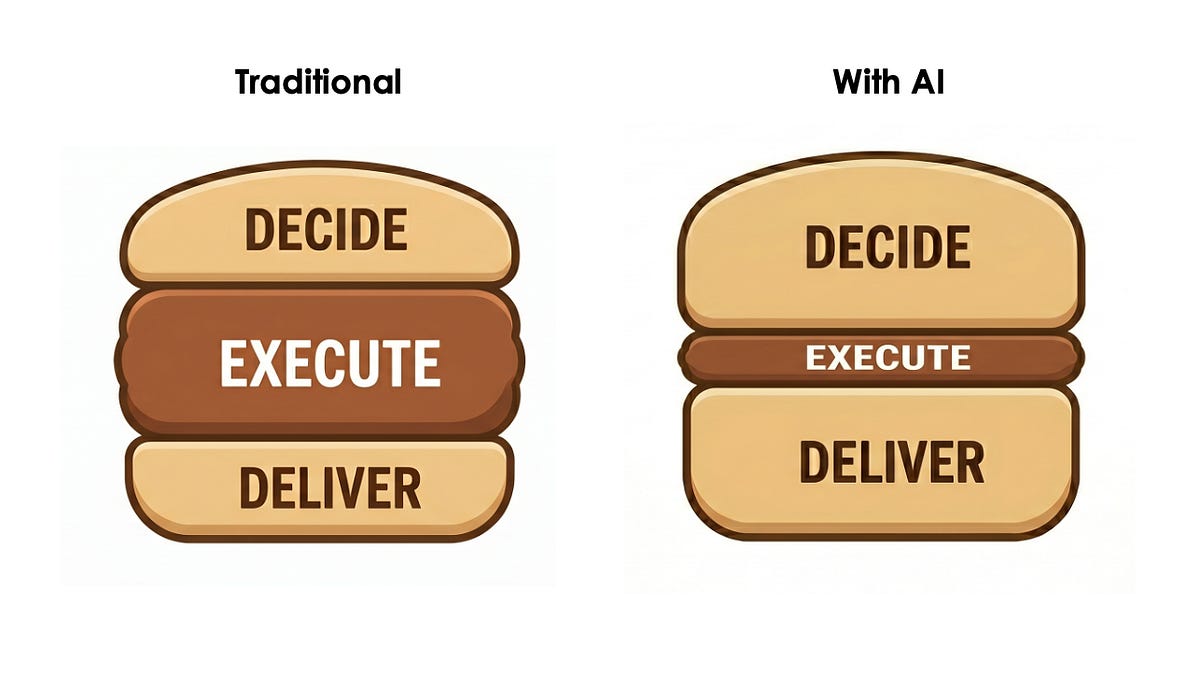
By execution, I mean the work of turning a product decision into software a customer can use.
With AI fully integrated into our development workflow, both the velocity and quality of the software we ship are noticeably higher. We spend less human attention on the code itself and more on identifying the right problems, deciding how to solve them, and understanding what will make the product better for the customer.
Execution is no longer the primary bottleneck in software development.
That is a bigger change than faster code generation. Software has traditionally required substantial time and a large team before an idea could be tested in the market. AI lowers both requirements. A product that once needed a large engineering team may now be possible with a handful of people working directly with agents.
The cost of being wrong falls with the cost of execution. More ideas can be built, tested, and discarded without putting a company at risk. Products aimed at small markets start to make economic sense because the revenue required to support the company behind them is lower.
This is where AI’s effect on software becomes more complicated. It is improving the way established companies build software while also making a different kind of software company possible.
Clayton Christensen gave us useful language for that distinction in The Innovator’s Dilemma:
Most new technologies foster improved product performance. I call these sustaining technologies. Some sustaining technologies can be discontinuous or radical in character, while others are of an incremental nature. What all sustaining technologies have in common is that they improve the performance of established products, along the dimensions of performance that mainstream customers in major markets have historically valued. Most technological advances in a given industry are sustaining in character…
And then there are technologies that change the basis of competition:
Disruptive technologies bring to a market a very different value proposition than had been available previously. Generally, disruptive technologies underperform established products in mainstream markets. But they have other features that a few fringe (and generally new) customers value. Products based on disruptive technologies are typically cheaper, simpler, smaller, and, frequently, more convenient to use.
AI can support both paths.
The trap looks like progress
The obvious way for an incumbent software company to adopt AI is as a sustaining technology. Give the existing engineering organization better tools. Use agents to complete work faster. Add AI features to products customers already buy. Increase output without changing the structure of the company.
These are real improvements. We are experiencing them ourselves. They are also the changes least likely to threaten the existing business.
The disruptive uses demand more. They require a company to reconsider how many people it needs, who can turn product decisions into working software, which customers it can profitably serve, and how it charges them. An incumbent may be able to build software with five people where it once needed fifty, but it already has the fifty. It has managers, processes, revenue targets, customer expectations, and a pricing model built around the organization it became.
The temptation to preserve that organization will be strong. AI’s sustaining benefits make the temptation stronger because they allow an incumbent to adopt the technology, show meaningful gains, and still leave the important assumptions untouched.
The trap is successful adoption on incumbent terms: enough AI to improve the existing company, but never enough to question the organization and business model it was brought in to sustain.
Sam Altman expected the disruption to arrive faster. In an August 2026 interview with David Senra, he said he expected GPT-4 to put software businesses up for grabs much sooner than it did. He now believes the transition will take longer because “the economy just has so much inertia.” People continue buying from the same companies and using familiar tools long after better technology exists.
That inertia gives incumbents time. It does not remove the opening.
The company that could not exist before
An AI-native entrant begins with a different set of constraints. Five people can do work that once required fifty. Product leaders can work directly with agents instead of handing specifications through layers of an engineering organization. Lower execution costs can support different pricing. A narrow market that could never fund a conventional software company may be large enough for this one.
Ben Thompson explains why startups make a different calculation in “Autonomy and Innovation”:
Human creativity and risk taking in the form of a startup, however, operates with a completely different risk profile. For startups the base case is failure; that means that anything that makes success more likely has positive expected value, which is to say that truly leaning into AI will be nothing but upside. Or, to put it another way, it is startups who will be the offensive hackers with nothing to lose by automating everything; it is the incumbents they will be attacking who will be so worried about losing what they have that they will keep humans in the wrong loop for too long.
Same tools, different incentives, and, in the very long run, very different outcomes.
Access to the technology may be equal, but the willingness to rebuild a company around it is not. The incumbent applies AI to a company designed before AI. The entrant designs the company around it. That difference reaches well beyond the engineering department. It changes which markets are attractive, what the company can charge, how quickly it can learn, and how much revenue it needs to survive.
Proliferation comes before consolidation
Public cloud computing produced a similar split. The underlying infrastructure concentrated among a few large providers while the number of companies built on top of it exploded. Startups no longer needed the capital or expertise to build a data center before they could build a product. Companies that could not have existed under the old cost structure became normal.
AI may concentrate models and compute in the same way while producing far more companies at the application layer. Mark Zuckerberg makes that case directly in “The Future Is for Everyone”:
People are starting to be able to manifest ideas themselves without having to raise money or build large teams. Many ideas that would have been too hard or expensive to try before will now be possible. This means we’ll see many more ideas and businesses.
Later in the article, he describes the likely structure directly:
Company sizes may shrink — just as they did in the transition from industrial giants to tech companies. But this doesn’t mean fewer jobs overall. It implies a larger number of companies with fewer people each. There are many more valuable companies and services to build than people are able to build today. I expect we will start seeing small numbers of people with personal superintelligence agents able to run companies at significant scale. In the future, small businesses will continue to be the backbone of the economy, but each small business will be able to have a much larger impact.
In software, many of those companies will be smaller and more specialized. They will serve markets that appear too narrow to today’s incumbents because they need less revenue to support the company behind the product. The total amount of software will grow because the number of problems that can economically support a software product will grow.
This proliferation will not last forever. As categories mature, some markets will consolidate and the advantages of scale will matter again. But consolidation is a later phase. AI’s first-order effect will be to create new companies, products, and business models; the market can consolidate only after the disruption creates them.
What becomes scarce
When anyone can create software, there will be much more of it. Technical execution alone will not separate the successful companies from everything else being built.
Product judgment, design, creativity, and customer understanding become more valuable as execution gets cheaper. Business-model creativity matters just as much. Different cost structures create room for different prices, customers, and ways of delivering value.
That deserves its own note. For this argument, it is enough to recognize that removing a bottleneck does not remove the need for expertise. It moves human attention to a different part of the system.
The cloud moved our attention away from infrastructure and toward software. AI is moving it away from implementation and toward the product and customer. Incumbents will benefit from that shift. Their products will improve and their teams will become more capable. Those sustaining gains are exactly what may cause them to miss the disruptive side of the technology.
The cloud allowed us to compete without owning a data center. AI will allow new companies to compete without inheriting the cost structure of a conventional software company. Incumbents can adopt the same tools. Escaping the organization those tools were brought in to sustain will be much harder.